Friday, August 31, 2012

From autonomy to independence

BOUGAINVILLE has just two years to address pressing issues before it can start talking about the question of referendum for independence, scheduled to take place in 2012.
Right now Bougainville needs to move ahead with economic recovery to provide employment, education and better health services. People’s lives must be improved to prove to all Bougainvilleans that life on the island was worth fighting and dying for 20 years ago.
This is probably how autonomy will be measured.
Time is running out and the benchmarks set under the Bougainville Peace Agreement — for example, Fiscal Self Reliance, Weapons Disposal and Capacity Building — must be addressed now rather than later.
Autonomous Bougainville President John Momis and the Administrator Lawrence Dising must take charge immediately. They must work closely with the PNG Government and the international community, including factions on Bougainville.
They have to deal with the Morumbi/Panguna issues if they are serious about referendum and independence for Bougainville. They have to deal with the Tonu Issue of Noah Musingku; the Weapons Disposal issue and the outstanding reconciliations. All this have the potential of hindering development and economic recovery on Bougainville and may torpedo the referendum for independence question in 2015.
The Post Courier, as a paper, has walked the journey with Bougainville since the Provincial Government days and through to the Bougainville Crisis era. We can see a big problem for the islanders ahead if a solution is not found to deal with all these issues. President Momis and his administration must deliver now.
People are willing; disarmament is possible; re-opening of the Panguna mine is feasible; economic recovery is possible; and independence is possible. All it takes is the right connections being made at the right levels to make the system work. Although much has been achieved in the past five years, many people claim there is nothing to show for it. Australia has been on its toes in the region developing, funding and assisting the ABG and the National Government on Bougainville.
New Zealand has done its bit with Law and Order; United Nations is there for many reasons and Red Cross is still there, although not with a big budget but with their heart! The churches and any non-government organizations are still struggling to get Bougainville back to normalcy. These organisations can only supplement what comes off the PNG National Government and the Autonomous Bougainville Government.
While the money-generating division, Commerce and Trade office details that the Bougainville economy is expected to increase within five years provided the Government address the pressing issues at hand — the region’s GDP is estimated to increase to K250m with cocoa to contribute about K110m, copra K18m, alluvial gold K30m per year and scrap metal another K30m. But all these cannot be achieved unless the problems detailed are addressed.
In light of this, the National Government must act now before anything comes up again! A warning to take heed!
Post-Courier

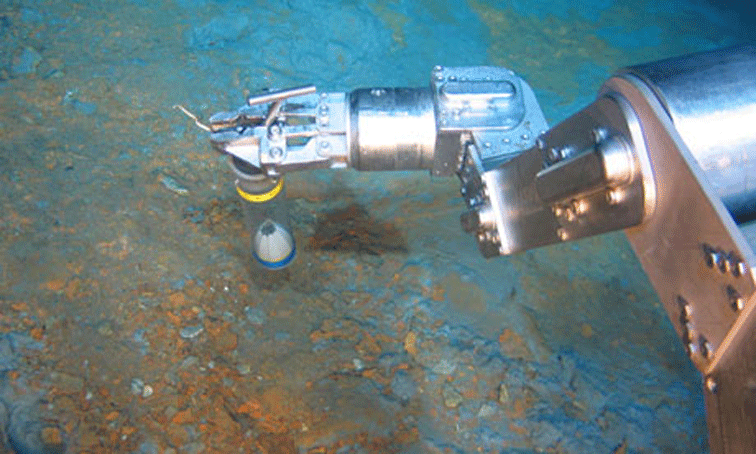
Modern technology machines can go underwater


Nautilus Minerals chief executive officer Stephen Rogers says there are misconceptions and misinformation about their plans.
In email and to the Post-Courier Editor in Chief and the Editor he said: “In an effort to clear up misconceptions and misinformation about our plans to retrieve
minerals from the the Solwara 1 project in the Bismarck Sea, here are some key facts.
“ Seafloor resource production is not new. Oil and gas turned to the oceans after
World War II and today, a third of the world’s oil and a quarter of the world’s natural gas are produced from offshore.
“Diamonds are recovered off the coast of West Africa. Much of the world’s heavy mineral sands containing zirconium and titanium come from under the sea,
as do large quantities of aggregate for Europe and the USA. While what we are doing is not new, Nautilus Minerals uses the world’s best technologies
and safest processes to meet and surpass international risk management standards.”
Mr Rogers said advanced robotics and remotely operated vehicles monitor seafloor activities.
He said Nautilus Minerals also invites and supports independent scientific and research observation.
“One question many ask however, is ‘Why go under the ocean when these minerals can be
found on land’?”
There are several good reasons he said.
“ The grade of sea deposits can be more than 10 times better than on land. This offers
commercial advantages. There are environmental benefits too. At the Solwara 1 project for
example, no mountains need to be stripped or moved. No trees need to be cleared and
the physical footprint will be very small — about a tenth of a square kilometre.
“There is little or no inconvenience to communities. No-one needs to move home. The
Solwara 1 site is 30 kilometres away from its nearest coastal community and 1600m below
the waves. Site activity poses minimal risk to fish stocks and people’s livelihoods. This has
been confirmed by extensive data gathering, modeling and scientific testing,” he said.
Mr Rogers said Solwara 1 will not use any blasting and will not discharge toxic chemicals into the water.
“In contrast to what some have claimed, the system is ‘closed’, and only filtered seawater is
returned to the deep sea, where it came from. No tailings will be discharged into the
ocean.
“Everyone familiar with the project knows we are open and transparent. We have (so far)
consulted with over 20,000 people, from remote villages to provincial capitals.
“In this spirit, our invitation remains open: if after reviewing our materials, anyone has
concerns, we welcome the chance to meet them, to answer questions and address
concerns — and if necessary, to do more work,” Mr Rogers said.
He said the economic, community and environmental benefits of seafloor resource
production are compelling.
“As land based grades continue to decline and the cost of recovery continues to rise, seafloor production provides an economically attractive,
environmentally safe and socially responsible alternative to serve worldwide mineral needs,” he said.
Mr Rogers said This is also an opportunity for Papua New Guinea to be at the forefront of evolutionary
developments in the resource industry, sharing in the profits, gaining new skills and
commanding worldwide recognition.

Ambitious plan for PNG


By NEVILLE TOGAREWA

THE O’Neill-Dion Government will undertake an ambitious, extensive and thorough review of the systems and processes of government in the next five years from 2012-2017
Governor General Sir Michael Ogio outlined the government’s five-year develoment agenda designed to correct past mistakes, heal political wounds and put the country back on track when he officially opened the ninth parliment on Tuesday August 21.

He described the new regime under Prime Minister Peter O’Neill as a government of reconciliation, unity and hope to usher in a period of stability and prosperity for the seven million people of Papua New Guinea.
”Our hope is to achieve the highest pace of development any government has ever achieved since independence 37 yeqars ago,” Sir Michael said.
The following is an edited version of the Governor General’s important address to the members of parliament and the people.

The important part of my message to you today is: what are we going to do and how we are going to make a fresh start?

During the formation of the government, our coalition leaders met in Alotau and put together a development agenda with programs designed to correct the mistakes of the past, heal the wounds of political infighting and guide our nation back on track in the next five years.

The new government will be a government of reconciliation, unity and hope for stability and prosperity. The lessons we have learnt over the last 12 months must not be repeated. Instead we will create an environment for stability and prosperity and promote reconciliation, resilience and unity. Our goal is to achieve the highset pace of development any government has ever achieved since independence.

To achieve this, our government has put together a platform of action that will be implemented during the term of this parliament. The strategies are designed to bring our people close by another five years to achieving the goals and objectives set under Vision 2050.

LEGISLATIVE REFORM
The government will undertake a major legislative reform program to review and amend a number of laws and acts of parliament. These laws have been identified for review and appeal.
We will review the provisions of the constitution, including those relating to the election of the Prime Minister, the term of parliament which is currently five years.
We will amend the Organic Laws on National and Local Government Elections and Integrity of Political Parties and Candidates to make them more effective and relevant to our needs today.
At the same time, we will enact new legislation to remove political uncertainty and create a stable environment for the government to implement its development policies, projects and programs.
In line with our desire to promote reconciliation and unity and to build respect for independence of the three arms of government, we will repeal the Judicial Conduct Act, the Supreme Court Amendment Act, Parliamentary Powers and Privileges Act and amendments to the Prime Minister and National Executive Council Act.
We will also pass an Act of Indemnity to indemnify all persons affected, as similar steps have been taken in other parts of the world.
To promote increased investment and free travel between our close neighbours Australia and New Zealand, we will pass a Dual Citizenship Act. We also plan to enact a law to set up the Independent Commission Against Corruption (ICAC).
Other important laws will also be reviewed and amended. They include NCDC Act, Public Service Management Act, Public Finance Management Act, Oil and Gas Act, Police, Defence and CIS Acts, Education Act, Electoral Boundaries Commission Act and Lae and Mount Hagen City Commissions.

FIVE YEAR DEVELOPMENT PLAN
The government will also review the Medium Term Development Plan. The five year plan will be fully costed and aligned to the annual budgets to include priority projects for provinces and districts. It will be the new road map for the O’Neill-Dion Government.

The priority impact programs will focus on the following programs:

EDUCATION
The government will extend the tuition fee education and subsidy policy to grade 12, provide infrastructure development support to tertiary institutions which will include housing for teachers in rural areas. Teacher training will be given priority to achieve quality education and a major review of teachers’ terms and conditions of employment will be done.
The government will also provide IT infrastructure and equipment to rural schools so that our children in remote and less accessible schools can develop their skills. Technical and Vocational Education Training programs will be given special attention and Community Based Skills Development Programs will be expanded. The Community College Program will also be reviewed.

HEALTH
The government will continue its commitment to accessible and affordable health by providing free primary or basic health care and subsidised specialist health care and encourage private health care services.
This will be achieved through the introduction of a National Health Insurance Policy in partnership with private health care providers. The government will also increase training of health workers, reopen all closed aid posts and improve the management of medical supplies and equipment throughout the country.
The government will also review the National Population Policy with the objective of making population as a major development agenda for the country.
Special attention will be given to containing HIV-AIDS and TB epidemics, non-communicable diseases and reduction of maternal and child mortality and cervical and breast cancer.

CORRUPTION
The government will continue to fight corruption in all its forms by providing proper funding and strengthening the inter-agency committee against corruption, especially Task Force Sweep, and introduce a bill to formally establish ICAC.
The powers and functions of the Ombudsman Commission will be review to identify and strengthen its core roles and given funding support.

INFRASTRUCTURE
The O’Neill-Dion Government will undertake a major review of the manner in which major development programs are planned, funded and implemented. A new authority will be set up under an Act of parliament to mobilise and negotiate funding and technical expertise in the country and offshore.
The authority will be tasked to oversee administration and management of major roads to link provinces to open up the country, as well as take charge of major economic and social infrastructure projects.
In addition, the Economic Corridor Concept encapsulated in the 2010-2030 National Strategic Plan will be implemented.
The government will also ensure that the multi-billion kina PNG LNG Project will be delivered on time with the first export in 2014 to provide the revenues to fund the five-year development agenda.
In this regard, the government will immediately set up a State negotiating team with membership from key agencies to negotiate a Gas Agreement with Inter Oil and its project partners. The team will work with Petromin as the State nominee to ensure that the best agreement is negotiated. Special considerations will be given to increased benefits for land owners and local and provincial governments.
The PNG LNG and Inter Oil Gas projects will underpin the country’s economy for the next 40 years.

LAW AND ORDER
Priority will be given to the restructuring of the Royal PNG Constabulary by creating the Office of the Secretary of Police. The recruiting process for the police commissioner and his deputies will be reviewed.
The restructure will allow the police commissioner to focus on police operations while the secretary will be responsible for administration and management.
A vigorous training program for the police will be done with the objective of increasing police manpower and funding will be provided for effective operations and improving conditions of employment.
Similar reviews and support will also be done for the PNG Defence Force and Correctional Services.
The government will also fund and support front line or village-based dispute resolution, community policing, land mediation and village courts as an integral part of maintaining law, order, peace and harmony our communities throughout the country.

PUBLIC SECTOR REFORM
The government will overhaulthe Public Service to improve efficiency and accountability. A performance based and outcome oriented polcy will be put in place for public servants at the natinal, provincial, disrict and local government level.
Current arrangements with respect to the department of Personnel Management and the Public Service Commission will also be reviewed. The department will be abolished and the commission will be restructed an given constitutional powers and functions to ensure public service efficiency. The PSC will be answerable to the National Executive Council.
The objective is to have a small office representing Personnel Management which will focus on deployment of public servants and training. The institute of Public Administration and its regional centres will be given special attention.
The government will introduce incentives for public servants, such asimproved salaries, affordable housing in both urban and rural areas and rewards for performance, as well as penalties for poor performance.
As part of the reform, the power of appointment and dismissal of provincial administrators will be vested in Provincial Executive Councils, not the National Executive Council. Parliament wil amend the Public Service management Act to give the NEC power to hire and fire departmental heads.
The role of the Central Agency Coordination Committee will be confined to monitoring the implementation of government policies and priority programs andmobilising agencies at the national, provincial, district and local government level to ensure effective delivery of goods and services.
The department of Prime Minister and NEC will assume overall responsibility of monitoring the implementation of development programs. The department of National Planning and District Development will be restructured and its functions changed to macro level planning, development of standards and collecting statistics at all levelsof government.
The National Statistical Office will be restructured to ensure that its capacity to collect data and tranbslate it into information for planning purposes will ccover all sectors and extend down to district and ward level.
The government will fully fund the Village Recorder program and fund it as part of the government program of effective service delivery.
Development funds will be disbursed through the annual budget to all the relevant agencies, provincial government and districts. The government will introduce a develoment program for all local level governments.

BUSINESS, SPORTS AND CULTURE
As part of the wealth-creation pillar of Vision 2050, the government will will develop and fund a comprehensive plan to open up customary land for development, especially for agri-business. It will also provide credit facilities for expansion of small to medium enterprises to help local businessmen and women.
PNG’s strong traditions and cultures will be protected and promoted, just as the country’s flora and fauna through conservation measures.

PUBLIC PRIVATE PARTNERSHIP
Under the government’s Public Private Partnership Policy, the public sector will be invited to partner the government to promoteefficiency andproductivity in State Owned Enterprises, job creation and increase income-earning opportunities for the people.
A partnership arrangement will be negotiated and the people, local and provincial governments, national financial institutions, unions, NGOs and churches will be invited to buy shares in SOEs, including PNG Power, PNG Ports, Telikom and Waterboard.

FOREIGN POLICY
The governemtn will review its Foreign Policy to ensure they are relevenat ot PNG’s and global requirements, takin ginto account business and investment needs of the country.
At the same time, the government will continue to focus on other important sectors. These include Petroleum and Energy, Land and Urban Planning, Forestry, Tourism, Fisheries, Environment, Conservation and Climate Change, Mining, Agriculture, Commerce and Business, Gender, Youthm Church, Women, Community and Sports, Inter-Government Relations and National Parliament.

CONCLUSION
Governor General Sir Michael Ogion concluded: “I have spoken at length about the government’s development agenda but this is not an easy task. Talk is cheap but action speak louder than words. The government will need the support of everyone from both sides of the House, public servants, the business sector, churches and the people. All of us have a role to play; all of us have a common objective to build a better an dprosperous future for each and everyone of us.”

Druggie eats live bandicoot


By Mal Taime

A drug addict was caught eating raw bandicoot yesterday.
The teenager from Mendi Southern Highlands ate a live bandicoot in South Wahgi district, Jiwaka Province after smoking marijuana.
Smoking marijuana makes smokers go hungry and it was obvious this teenager was so hungry that he ate a raw bandicoot.
The teenager is a drug addict and resides at Block 10 with some Southern Highlands that worked for WR Carpenters (Kudjip Tea Estate) in South Wahgi district in the Jiwaka Province.
Kudjip Tea/Coffee councilor Jacob Ali said the druggie was found eating a raw bandicoot when they caught him.
Mr Ali said: “We asked him why did you eat this raw bandicoot and he replied saying that it was good food for him after smoking marijuana,” he said.
Some frustrated youths beat him but he did not sustain any wounds and was laughing at them.
According to Mr Ali the druggie also went into a pig house and asked a pig to give him a fire to light his smoke.
Mr Ali said: “They found him asking a pig for fire to light his.”
He said this was a first time for the people to see such young man eating raw bandicoot that feared them.
Mr Ali said they feared he might eat children because he had already tasted blood.
He said this was related to drug and appealed to those that were smoking marijuana must stop because this is a dangerous plant.
SOME youths surrounding the druggie on Tuesday at Kudjip Tea in the Jiwaka Province with the raw bandicoot.

Chairman urges Kulunga to support Task Force Rausim Alien


CHAIRMAN of NGO’s and Civil Society Coalition against Corruption Mr Philip Kepan urges Police Commissioner Tom Kulunga to support the ‘Task Force Rausim Alien’ and its team leader John Briain in its efforts to uncover corrupt practises by Asians.
“The Commissioner started well with the elections and to keep his good reputation, he has to complete current tasks which are of both national and international interest,” Mr Kepan said.
He said to give back a good reputation and respect for the department from the public outcries, the Police Commissioner has to give the necessary support needed by the task force to produce quality results.
Mr Kepan said the public, business houses, international communities and even churches who have been diligently serving this nation. They have a concern on this kind of issues where corrupt practises are applied to make fast money and in the end make the nation corrupt as well.
“Individuals and institutions that have served this nation from nothing to its current status do not like national leaders, senior bureaucrats and members of police collaborating with foreign syndicates,” Mr Kepan said.
He said that rarely department heads have been publicly recognised for their outstanding performances as public servants serving PNG with real concern for its people. It would be so great if the Police Commissioner Tom Kulunga take the lead to continue the pace he started so far to stop this recently introduced but fast growing rot trying to eat away the nation.
He also said those different groups of people are aware of national leaders who are behind these corrupt deals by Asians.
He said national leaders and top public servants should come out and express their stand rather than sitting idle and come out where there is a public comment or statement made by an individual.
The Chairman also said that the current government has publicly declared war against Corruption but to what extend and approach will this fight be carried out.
“That is what the concerned citizens’ genuine businesses in the nation are closely waiting to see.
“Every Individual and institution in this nation knows well which Asians have been living for so long in the Country and what they have done to honestly serve the nation in terms of social and economic benefit. The people also know which Asian have come in recently to do businesses for personal gains.
“I also urge the Police especially “Task Force Rausim Alien” to investigate those involve in deregistering genuine businesses involve in Agro-Forestry and Oil Palm projects and the Immigration Officials overlooking their guidelines to tolerate briberies,” said Mr Kepan.

PAIAS WINGTI: CAN HE BE SEEN AS A POWER BROKER OR THE OPPOSITE?


By CHRISTOPHER PAPIALI

In the early 1980s and late 1990s, Hon. Paias Wingti was revered as the best and adorable leader in the Highlands region. His face resembled hope and his voice gave comfort to pounding hearts. He has now entered parliament again. He has not made any straight shooting messages for the people of the Highlands region and his WHP.

What inspired me most was his sitting arrangement, this time sitting side by side with Sir J, Sir Michale Somare and Hon. Peter O'Neill during the preliminary formation of the current government.

He was seeing courting Hon. Peter Ipatas on the floor of parliament when they signed and declared oath as MPs of the 9th PNG Parliament Opening. Both of these highlands leaders did not make any joint statements and neither of them wanted to speak one for the other.

If Paias Wingti is very quiet and continues to do things without much publicity then his aim to become a remarkable and strong character in the Highlands could be seen as introvert and therefore can not command authoritative figure in this futile, harsh and competitive environment.

Many people seem to shy away and those who have lived during his political life view this adorable leader as platinum multimillionaire. Whatever the story may be, Paias does not want to declare himself as some of our arrogant and toffy nosed leaders do.

The message is clear. He has not openly declared himself of his fortunes and investments like others do. He is resilient and seldom does he boasts of his standing as an rich iconic leader in Asia Pacific.

The people of WHP have voted him and Tom Olga is seen to be accepting his defeat because I have not heard lately of any complaint filed at the Court of Disputed Returns.

One thing is clear and that is the people of WHP, the province that boasts the robust economic nerve centre of the highlands region, seem to see politics as means to muscling the lineal and family business ventures and for this reason the Western Highlanders are sometimes described as another Chinese of Papua New Guinea.

With the spirit of wealth accumulation and lineal supremacy, the people of WHP can not be left at the backyard when it comes to making political decisions of PNG. The people together with their Governor have something in common. This very peculiar resounding unity seem to have surfaced in this term of parliament.

What has surfaced now after years of remaining as a watchdog is the remaking of the image of Hon. Paias Wingti. The image of this leader has to be the making of the people of Western Highlands Province themselves. They safeguard their Governor, (as it seems) and none of them openly discuss anything on Paias Wingti. As it turns out to be the stories surrounding Paias Wingti seem to come from others and not from his inner circle of friends.

With Paias, the people of Western Highlands Province see great prosperity in their province. Sharing WHP, is SHP, Enga, and Simbu. The Enga Governor seem to have moved away from the notion on wealth creation including two of his counter parts from SHP and Simbu. For SHP, the new inexperienced governor can not wear the shoe of Paias and Ipatas. Hon. William Powi has to sort out the political in-differences crippling the growth and development of SHP. And same can be said of the new Simbu Governor.

Having said this, what is important for us to learn from the people of WHP is the belief they have in prosperity. They endure hardships to maximize their returns.

We are then beginning to formulate all kinds of ideologies surrounding the return of Hon. Paias Wingti. One can go on expounding on those ideologies but for sure we do not want to be confused by those ideologies that can be self imposed, accepted at face value, or from any hearsay.

The most intriguing nature of Paias, remaining quiet and avoiding all those media hype goes back to himself and no body else. He has now chosen to remain so calm, so quiet and only he, himself can liberate his self-consciousness. He owes his leadership to the people of WHP.

The life and duration of the O'Neill government can not be visibly stated as being controlled from the engine room, which can be falsely stated as Paias sitting side by side with Hon. Peter O'Neill, Sir Michael Somare and Sir Julius Chan in that engine room.

Tuesday, August 28, 2012

Shell In Talks With InterOil On Papua New Guinea LNG


By Alexis Flynn; 
LONDON--Royal Dutch Shell PLC (RDSB.LN) is in talks with liquefied natural gas producer InterOil Corp. (IOC) that could lead to the Anglo-Dutch energy giant buying into the U.S. firm's Papua New Guinea exploration license areas, Shell's two most senior executives said Thursday, although neither was prepared to be drawn on where discussions may lead.
"We have been in talks with InterOil and other interested parties, but we can't say where [they are] going," said Chief Financial Officer Simon Henry.
Papua New Guinea-focused InterOil holds three prospecting licenses onshore the south-east Asian island nation, where early appraisal drilling has revealed vast natural gas reservoirs are located.
The firm also plans to build a 9 million metric ton a year LNG terminal in Papua New Guinea but will need partners to help cover some of the estimated $6 billion required to build a two-train processing plant.
It is currently soliciting interest in the sale of a 25% stake in the LNG project.
Shell Chief Executive Peter Voser skirted a question on whether Shell was preparing a takeover bid for the Houston, Texas-based firm. Shell recently pulled out of a bidding war for Mozambique-focused prospector Cove Energy PLC (COV), citing the high cost of the acquistion relative to other growth opportunities within its existing business.
"It's an interesting play there," said Mr. Voser. "We have talked to the government, we are looking at it," said Mr. Voser, adding that any decision on investing in Papua New Guinea would have to be framed against its wider portfolio.
"At the end, it will be profitability driven. It will be: Can we do a project in a safe and reliable way, and will it deliver the performance? I think to answer that question, it is too early for that," said Mr. Voser.
InterOil wasn't immediately available for comment.

Papuans claim Australian link to death squad


An elite counter-terrorism unit trained and supplied by Australia is being accused of targeting and killing independence leaders in Indonesia's troubled West Papua region.
The group, known as Detachment 88, receives training, supplies and extensive operational support from the Australian Federal Police.
But there is growing evidence the squad is involved in torture and extra-judicial killings as part of efforts by Indonesian authorities to crush the separatist movement in West Papua.
  • The AFP were contacted by 7.30 and outlined their involvement with Detachment 88 - read here.
  • Read the Indonesian Government's response to the 7.30 coverage here.
The ABC's Hayden Cooper and Lisa Main went undercover in the restive Indonesian provinces to meet with many who say an Australian Government-funded anti-terrorist team is waging a bloody campaign against activists.
On June 14, popular independence leader Mako Tabuni was gunned down as he fled from police on a quiet street in the Papuan capital.
The men who killed Mr Tabuni allegedly are part of Detachment 88, which was established in the wake of the Bali bombings.
Trained in forensics, intelligence gathering, surveillance and law enforcement by officials from the US, the UK and Australia, they have played a crucial role in Indonesia's counter-terrorism efforts.
They are ruthless, often killing suspects, and their anti-terrorism mandate is now creeping into other areas like policing West Papuan separatists.
In December 2010, Detachment 88 killed militant Papuan activist Kelly Kwalik.
Mr Kwalik was a leader from the Free Papua Movement (OPM), a violent independence group with a record of attacking military and civilians, and Detachment 88 publically claimed responsibility.

'Gentle way'

But KNBP's current leader, Victor Yeimo, say unlike OPM, KNBP is non-violent and instead pursues a political solution.
"Mako was a good man. If someone was angry, Mako wouldn't answer them," he said.
"Even if people were angry, if he was being questioned by the police, they'd speak to him but he'd just laugh.

"His way of fighting back was by doing interviews and press conferences, it was gentle.
"People say he had weapons and so on but I was often at his house and I never saw a pistol and nor did my friends."
According to eyewitnesses, after being approached by plain-clothed police in unmarked cars, Mr Tabuni attempted to flee.
The witness said police opened fire on the activist as he ran down the road.
"He got free, he ran across the road, he ran about two metres alongside the taxi rank," one witness said.
"He ran along the taxi rank and tried to climb down into a gully, a drain, under the bridge.
"He was shot in the leg, he was shot but still tried to escape, then they shot him in the torso."
Bleeding heavily, Mr Tabuni was taken not to the nearby Catholic hospital, but to a police hospital at least 20 minutes away where another witness saw the authorities bring him in.
"When he came in, I was shocked. I didn't know what had happened and it was a shock," he said.
"They brought him in and all they did was wash off the blood."

'No evidence'

The man says the police were from Detachment 88 based on their distinctive masks often worn in operation.
"I could tell just from the way they looked. And when they brought him in, the people carrying him were wearing masks," he said.
Gustaf Kawer, Mr Tabuni's lawyer, also believes Detachment 88 was involved.
"They used an ordinary car and also a ute. Usually, when the police make an official arrest they wear police uniforms and use police vehicles," he said.
"But they acted as if this was not an ordinary case, as if they were dealing with terrorists."

The Indonesian police report claims Mr Tabuni had a gun when he was shot and that he grabbed another weapon off one of the officers.
They also claim he was involved in seven violent offences before his shooting.
But Mr Kawer, who is respected internationally, says there is no evidence for any of the claims.
"I think it's all a scenario created by the security forces so they could shoot him," he said.
"At the present time the police are only holding two of the people who are alleged to be involved with him. They're still being held by the police.
"Witness testimony points to their being involved but there's not enough evidence against Mako."

Without restraint


The activist's death is just one of many examples of Detachment 88 operating with impunity.
A leaked video surfaced last year showing Indonesian police after they had reclaimed a remote airstrip from militant separatists.
The trophy video taken on a mobile phone by the police identifies Detachment 88 officers, who are often embedded with other units, and dead Papuans lying on the ground, including pictures of teenagers tied up with ropes.
And witnesses say Detachment 88 was among the security forces that opened fire on civilians at the Papuan National Congress last October.
To Papuan activists like Mr Yeimo, Australia's support and training for Detachment 88 is galling.
"You give money for Indonesia to kill people in West Papua - you are the perpetrators of violence in West Papua," he said.
"[The] Australian Government and American government, they are actors of violence in West Papua.
"Because they find them, they train them and then with the gun they kill people, they kill us like animals."
Mr Tabuni's death has sparked the attention of the Australian Government, with diplomats in Jakarta raising concerns about the killing with Indonesia on August 7.
And the Federal Government says it is asked Indonesia to conduct inquiries into human rights abuses and killings in the province of Papua.
Foreign Affairs Minister Bob Carr says he does not know if the reports are true, but he says he has spoken with his Indonesian counterpart, Marty Natalegawa, about the issue.
"Well we think the best way of clarifying the situation is for an inquiry. We've never hesitated to raise human rights issues in the two Papuan provinces and we'll continue to do it," he said.
But Australia's response is little comfort to the independence leaders in the divided and dangerous region.
Mr Yeimo says his people have little faith that the world really cares about their plight.
"The world is behind Indonesia now, it means they all compromise with Indonesia to kill West Papuan people," he said.
And he knows that he too is now in the firing line.
"The three days after Mako Tabuni was killed by Indonesia, they sent a text message to me, they said to me that 'after Mako Tabuni's dead, you'll be next'."

What’s in asylum for our people?


THE National Executive Council or Cabinet has given Australia the green light to reopen the Manus regional processing centre for boat people seeking asylum and citizenship in Australia.
The Peter O’Neill-Dion Cabinet made the decision four days ago on Thursday following a formal request by Prime Minister Julia Gillard on behalf of the Australian Government.
The boat people, mainly from Indonesia, have created a major problem for Australia, and Canberra has been trying for years to find a solution to what has become a major human tragedy.
Many of the boat people - men, women and children - have died trying to seek a better life in Australia. They have been detained in facilities in Australia and there have been allegations of mistreatment of these people by Australian authorities.
The problem of asylum seekers or refugees is an international issue and dates back to biblical times - when Moses led the Israelites out of Egypt ruled by a tyrant Pharaoh to flee from slavery and death to “a land of milk and honey” – and even before then.
While some Papua New Guineans may argue against the Cabinet decision, there are equally strong arguments why Prime Minister O’Neill and his Government took the decision as it did.
Firstly, PNG is a member of the United Nations and it has international obligations under international laws and conventions. One of these is the treatment of boat people or refugees. Bilateral agreements between Australia, Indonesia and PNG will also come onto play here.
The problem of boat people is not Australia’s alone. It affects every country in the region. PNG, Australia, New Zealand and the other Melanesian Spearhead and South Pacific Forum countries are not only legally but morally obligated to do what thay can to help.
In this regard, Prime Minister O’Neill and the Government must be commended for taking the lead to help resolve what has been, and continues to be, a serious international matter.
Many questions remain to be answered, questions like: What are the roles of the Australian and PNG Governments and the UN High Commissioner for Refugees? What benefits are there for the people and government of Manus in particular and PNG as a whole?
One thing we know is that the processing centre will be funded under a seperate funding arrangement between Canberra and Port Moresby, over and above the current aid or Overseas Development Assistance package between the two countries.
This is according to Foreign Minister Rimbink Pato, who has has been tasked to take the key role and lead the PNG negotiation team and things will be firmed up after Prime Minister O’Neill’s meeting with his counterpart Julia Gillard in the Cook Islands.
Whatever the final solution is for the boat people or refugees, one thing is very clear: this matter, essentially is Australia’s responsibility, according to UNHCR regional representative Richard Towle. “Australia may choose to transfer physically people to other jurisdictions, but we believe that under international law, very clearly, Australia is not absolved of its legal responsibilities to protect people through all aspects of the processing and solutions,” Mr Towle said.
Post-Courier

Opposition begins district visits


The opposition has begun visits to district to see service delivery levels.
The start was to Goilala in the Central Province where opposition leader Belden Namah accompanied the Goilala Open MP Daniel Mona.
First impression for the opposition was the lack of road despite the existence of the Tolukuma Gold Mine.
Michelle Amba reports.
Speaker inserted;
  1. Belden Namah-Opposition Leader
  2. Fr.Brian Cahill- Board Chairman, Tapini Secondary School

Highway at risk


By TODAGIA KELOLA

CONSTRUCTION of the Trans National Highway linking the Southern with Momase and Highlands regions may be jeopardised because monies appropriated to pay for these projects have been withheld by the Works Department, although the work has been fully completed.
The previous O’Neill-Namah Government through the 2011 Supplementary Budget allocated K6 million for the maintenance of a 12km stretch of the existing road and another K10 million in the 2012 Development Budget for the construction of Malalaua-Kaintiba road in the Gulf Province, which will eventually link Aseki in the Menyamya District of Morobe Province.
The then O’Neill-Namah Government had prioritised this road project as one of the key priority impact projects to link Papua with Momase and Highlands region to make this major Trans National Highway linking the country a reality.
The road construction work was awarded to SNP Construction Limited and the necessary contract papers were signed by the Company and the Works Secretary.
The company, after signing the contract, immediately implemented the work project as per the contract agreement and the work was completed and certified by the Provincial Works Manager for Gulf Province. However, when they submitted their invoices to the department for payment the Works Department has been reluctant to honour its part of the agreement.
A director of SNP Construction Limited, Henry Goare, has written numerous letters to Secretary Joel Luma but for almost seven months no feedback has been forthcoming and the company is now wondering how to sustain its operations.
“The construction of Malalaua-Kaintiba-Asek Road was facilitated by the Gulf Provincial Supply and Tenders Board and the initial road construction works commenced. The construction works includes new alignment, clearing and grubbing and felling of trees,” Mr Goare said.
“Our company has executed the above works as per the contract agreement covering almost 40km up to Kotai River.
“However, when we submitted our invoices to the department for payment for progressive works, Mr Luma advised us and the late Pitom Bombom through a letter that the PSTB Agreement was flawed and therefore the contract should be facilitated at CSTB through public tender, hence this has dragged on for too long,” he said.
“This is one of the key priority infrastructure projects of the former O’Neill/Namah Government and therefore the department shouldn’t in anyway cause any further delay in facilitating the Contract Agreement at CSTB.
“The construction work continued and importantly, Kaintiba people who had been denied a road network for the last 30 years can have their coffee and other agriculture produce sold at better markets in the city,” Mr Goare said.
He said for the last 15 years, the people have suffered because there was no road for them to travel. It would take the people almost 36 hours to walk from their villages to Malalaua just to buy a bag of rice. But now after the completion of the road by SNP Construction Limited, PMVs have started to move in and the people are now easily travelling to Malalaua and Port Moresby but the company that made it possible is suffering.
Several email attempts by this newspaper to get comments from the Works Dept. Secretary were unsuccessful.

Parkops call for use of army misguided and foolish


I find the proposition by the NCD Governor to call out the army to police the streets of Port Moresby very amusing, misguided, and at worse, foolish, from a supposedly learned politician. Though the idea seems politically correct, it strikes dumb, and is totally misplaced.

Why does the Governor think using the armed force could deliver a positive result in combating crime in the City? Or could this idea be just another of his egotistic and attention grabbing stunts in the media just to square off with some of the initiatives of the Government recently announced by newly appointed ministers?
But if he does mean that, Is not unemployment and lack of job incentives by the Government over the years, one of the single most causes of the level of crime we experience today, that this issue should be addressed by NCDC and through such an intervention? I wonder where this idea has come from. Could there be another motive? However in considering the Governor's  proposition on its own merit, the idea appears politically correct, but seriously lacks political smartness.

 You may ask why all this has to do with being politically correct and politically smart? But a lot has got to do with it and a lot can be at stake from a misguided political move. Political correctness does not spare anyone from been politically ignorant. Here’s why I think the Governor’s proposition is starved of any logical and sensible reasoning. Firstly, the role of combating crime in NCD is not a core function of NCDC, neither is it the direct responsibility of the Governor.

Whilst NCDC could help, it does not make any sense that it could lead such a campaign. Secondly, the Governor does not mention the possible tradeoffs or costs related to his idea of using the army nor does he discusses how his proposed policy would interact with other policies and issues in the event it usurps this role.

The fact is that, the use of the army to police the streets of Port Moresby will be a futile attempt to correct the state of crime in the city, as would all other short term, unrelialistic, and quick fix solutions to deal with long term issues would confront. The use of the army just would not curb unemployment issues which is the root cause of crime. At best the involvement and participation of the army to address crime would contribute, is an added burden and an absolute strain on NCDC budget, as the Defense Department will not be responsible for  any logistical costs, allowances, and other incentives for its personnel to participate in duties outside of their normal function.

The involvement of army is therefore just not an effective and viable solution to curb crime. Obviously the Governor simply does not get it. The Governor seems only focused on vivid issues which would amplify his standing widely in the City and the country through endless publicity, yet he ignores one of the most important issues, which is the issue of appropriating valuable and limited resources towards programs.

Valuable resources are often misused, squandered and ignored in unrealistic and untenable programs. Could this initiative by the Governor be just that? For NCDC to take on this policy which is also outside of its core function, will mean redirecting resources away from other important programs which address the much needed services for rate payers in the City.

The impacts will definitely be felt down the line. How could the Governor be so concerned about the welfare of the people of NCD by confronting crime with such an idea, yet be so ignorant and careless about getting the other core essential services right for the interest of the same residences of the City? Are the dangers of crime anymore serious and concerning than the concerns of ill-health of residents from the dirt and filth Port Moresby is presently riddle with.

Or are the concerns of the free movement of people without been hassled and harmed by criminals anymore critical than a couple of children dying in the hospital as a result of a very dirty and filthy City environment? Some of the issues which the City now confronts, are the result of the Governors foolish decisions to over-commit NCDC budget on unrealistic and counter-productive programs.

For example, the decision by the Governor to build water fountains in the city two years ago for scenic pleasure, mind you a single water fountain coasted the Commission in access of K250,000, had been at the detriment of various vital services which the Commission could have addressed, the consequence of which are felt today. The build up of dirt and filth in the city today which is compromising the health of residents, the lack of proper traffic signage on the roads in the

City which is compromising the safety of road users, the collapse of compulsory services such as effective garbage collection, regulatory and monitoring function of the Council which is endangering lives, are a result of past bad decisions by the Governor. In recent times, the Governor announced taking on the Government in the Courts over the Manus asylum centre issue, which would have undoubtedly led to unnecessary costs to the Commission if pursued and a denial of another vital service to residents of the City.

The Governor thinks NCDC resources are vast and diverse and infinite, that he could squander them on programs of his preference and choice. The best the Governor could do is to get NCDC to contribute where it could to strengthen the capacity of an established State institution (the Police Department) responsible to combat crime in PNG and in the City and not take on the campaign.

For now it does seem the Governor has his priority all set wrong as his preferences on issues appear a mismatch to NCDC’s charter, let alone, its capacity to take on. The Governor’s poor decisions appear to be only stifling life out of NCDC from addressing its key functions and responsibilities, thus denying residents of vital services.

Keslin Hami

Sunday, August 26, 2012

An open letter to Mel Togolo* on seabed mining

Mel Togolo


WENCESLAUS MAGUN | Australian Association for the Advancement of Pacific Studies
GOOD MORNING MEL [pictured]. I have great respect for you but not for Nautilus's experimental seabed mining.


I know deep within your heart and in your subconscious sense, you are not in favour of the experimental seabed mining.
As an ex seminarian, I challenge you to probe once again into your moral and ethical decision to support Nautilus a foreign company that truly does not care if the lives of indigenous Papua New Guineans are going to be affected or not should there be any risk occurring.
The company and the Government of Papua New Guinea does not have the infrastructure, funds, and the capacity to mitigate any such unplanned risks. You have not taken into account the precautionary principals as your primary social responsibility.
You are only developing your Environmental Management Plan. Logically this should have been the first thing to do and that you should have gauged views from the public prior to requesting to be granted a 20-year mining lease licence.
Believe me we are no longer ignorant and fools and can easily be listening to your crap of lies. We now know that your experimental seabed mining will have more negative detrimental impact on our marine habitat, cultures, food source, and dignity.
Whilst I am not a lawyer or a marine scientist the facts presented to us by our scientific advisor Professor Richard Steiner, Dr Helen Rosenbaum and other journals on this subject gives us sufficient information to believe that your experimental seabed mining will have more negative impact to us in all fronts than the gains you boats so much of.
Listen Mel. PNG is your country. We are your people. Stand up for us now.
The National Fisheries Authority, the Opposition leader and his team in the Opposition, Governor for Oro, Governor for Milne Bay, Governor for Manus, Governor for Madang, New Ireland Provincial Government, the resource owners of New Ireland, East New Britain, Madang, Milne Bay and university students from these respective provinces as well as individuals, scientists, learned friends from PNG and abroad are all opposed to your venture and are supporting our call to stop your experimental seabed mining.
We are united! We demand that you tell your associates in Nautilus to pack up and leave our waters, our sovereign independent State of Papua New Guinea where our forefathers have lived for more than 50,000 years.
They knew better how to survive on their land and sea and we desire to follow their footsteps. Our natural resources have provided sustenance and shelter. We have deep spiritual and emotional connections with our environment that gives us our dignity.
Nearly all our indigenous tribes on this land recognise this reciprocal relationship. We desire to pass on the pristine, unique, diverse biodiversity and habitat from our natural resources to our children and grand children and great grand children of which we have borrowed from them this richly blessed country.
We are custodians to our resources and have an obligation to ensure that all is well, safe, healthy and friendly as stipulated in the Somare Temu Vision 2050 statement.
We cannot sit back and continue to remain passive to the ongoing pollution and pillaging of our rich habitat and biodiversity, traditional cultures, and spirituality by some neo-colonialists wearing the sheep coat as pioneers of seabed mining boasting of "redeeming" us from our economic and social woes.
Money is not the essence of life. Life comes from God. And that life is sustained by the beauty and abundance of our natural resources. We have been called upon to be stewards of God's creation. This is our strength.
Finally, Mel, how comes you are responding now to Gangai and not to my list of questions I had sent to you almost a year ago?
I have great respect for you but not for the industry.
Cheers,
Wence

O’Neills Manus Decision is Inhumane, Illegal & Otherwise Unconstitutional

By Melanesian
In Australia the Labour Party led by their PM Gillard are now making a 180 degree bout turn on their Refugee Policy. They appear to have abandoned the Malaysian solution and have now embraced the Pacific Solution, which they went to the elections opposing Liberal-National Coalition Parties on. How fickle and untrustworthy Politicians can be anywhere, let alone Australia!
What this signifies is a shift for processing of boat people and Refugees in PNG ( Manus ) and Nauru.
In the past the NA led Somare government has opposed the processing of Refugees in PNG. There were very good legal and human rights reasons for this policy. This refusal was based on proper legal advice. That it is unconstitutional and unlawful to have an asylum processing centre in PNG, like the one in Manus.
The Manus processing centre is a closed jail like centre where there is heavily armed security, and is out of bounds to the public and the media. It is a strictly controlled environment where the Refugees are not allowed to mingle with locals. They cannot leave the site. There is a very strong fence that cannot be assailed and armed guards are posted everywhere. No one, including lawyers, are allowed access to any Refugee under the Bi-lateral arrangements between Australia and PNG. Most of the contractors and suppliers of food and consumables are companies out of Australia, so there is very little tangible economic benefit back to PNG for this exercise.
The UN Convention & Protocols Relating to the Status of Refugees Refugees (Refugee Convention)1951 & 1967 Protocol (“Refugee Convention”) clearly outlines that a signatory government like Australia cannot transport refugees to a third location like Manus or Nauru, unless there is a guarantee that these countries will not persecute them, they would not be oppressed, and that their human rights will be protected. Until PNG can give a guarantee that the human rights of the refugees will be guaranteed and protected, Australia is obliged by the Refugee Convention not to transport them at all, but to process them on Australian soil. Irrespective of whether a person’s status as a Refugee has been determined or not, the processing of boat people who entered Australia or apprehended by Australian authorities, must principally be done in Australia and on Australian soil, under the Convention. This is an implied international obligation of Australia under the Refugee Convention. The decision to transport them out of Australian legal jurisdiction can only be done if the Australian government can guarantee the physical safety, security, human rights, and speedy processing of their Applications to enter and remain in Australia as Refugees. Past experience shows clearly that Manus is an oppressive environment for the Refugees.
For a long time the Australian government has been looking to curb or discourage boat people flooding its shores by deliberately employing cruel and inhuman treatment of asylum seekers, boat people or refugees. In some cases children and babies have been held in captivity and jail like conditions for years and years without any ounce of recognition or consideration for their humanity. Families have been rendered asunder, and in some cases lives have been destroyed. Many people held in captivity in jail like conditions in Australia have been left with permanent psychological scarring. Others have gone on hunger strike, committed suicide, or even sown up their lips to demonstrate that they are a people without a voice discarded as garbage by the Australian Federal Government and its leadership.
Last Christmas, we watched in horror as the remains of a boat carrying over 300 men women and children smashed mercilessly against the rocks on Christmas Island, were gathered up piece by piece and limb by limb. The Australian Navy, Coast Guard and its surveillance system picked up the boat many hours before they struck tragedy. They knew the heavily laden boat was headed for the rocks in bad weather. Yet, they stood by and allowed these people to sail directly to their death. The Prime Minister of Australia and the Defence Minister of Australia at that time may have been made aware of the impending tragedy, and may have chosen to turn a blind eye. This is not the first time Australia has deliberately allowed boat people to drown. This policy of watching and waiting and turning a blind eye to people in peril at sea does not sit well with the Australian Navy, who has made it known to the politicians that they have sworn an oath as seamen and women to save lives of other seafarers. The manner in which the politicians in Canberra appear to expect the Navy to break a time honoured code of ethics of seafarers is not sitting well with the higher ranks of the Australian Navy. Some servicemen and women have suffered psychologically as a result, having watched and stood by while innocent men women and children whose only crime was to come to Australia, daring to dream of happiness and to seek a better life and a better future, being plunged to their certain deaths.
The Refugee Convention is very clear that it is not a crime for human beings, people of one country to leave their country and go seek a better life in another country if they suffer persecution in the original country on grounds of race, religion or political belief. As a matter of fact it is a fundamental human right to live in peace in a safe and secure environment, and the Convention provides for and gives effect to this right and the sacred sanctity of human life and the inherent dignity of every person.
Australia has over the years done everything under the sun to persecute, desecrate and demonize asylum seekers, refugees and boat people. Yet when it comes down to it, Australia is a country of boat people. White Australia is a country of boat people and their descendants. What gives Julia Gillard and her Cabinet any more right to Australia than those latterly arrivals on Aborigines soil? It is only a matter of timing. That is all. White Australia has no more legal, ethical or moral high ground to claim Terra Australis than these boat people. This behoves Australia to adopt a position, a moral and legal position that is concomitant with a full understanding and appreciation of the full surrounding circumstances causing plight of people around the globe; and in this sense their own part in the invasion of other countries and causing demographic political religious and economic instability in certain parts.
Australian Leaders equally fail to see the full benefits of a healthy Immigration Policy that treats people with dignity. The policy is ridden by every political jockey as if to ensure the next load of boat people do not get in at all was a virtue worthy of the highest political goal score and inverse personal credibility, be it government or opposition. The fact that they don’t have an open quota system, prescribed open criteria, and aggressive selective migration policy, allows for some people to capitalize on it to set up money making operations to do boat runs with people who would otherwise be decent and skilled human beings in any society. The front page right hand column of The Australian last weekend says Australian Government internal studies reveal that it will need 800,000 new skilled workers in 5 years’ time! It expressed grave concerns for the Australian economy that it cannot be in a position to meet this demand. How poetically paradoxical was this page as it had right across the top in bold was the headline “Labor floats Nauru solution”. Now even if every able bodied Australian female, and every hot blooded beer swirling meat pie eating fly swatting footy crazy Aussie male, start fornicating non-stop for the next 6 months, they still will not produce the 800,000 skilled workers needed in 5 years’ time to meet the demand forecasted. That is one reason why, Australian Migration Policy as closed discriminatory and insular as it is, driven by a psyche of isolation and out-dated phobias, need to be sat on its head and overhauled to meet the challenges of the next century, or it will surely suffer being left behind as a land of red necks.
Clearly the Manus solution in Papua New Guinea is illegal and unconstitutional under international law as well as under PNG law. Among other reasons it is illegal because:
1. It deprives the liberty of people to be held in Jail like lock ups. Under the PNG Constitution we cannot deprive the liberty of persons unless they are convicted of a crime, or the Police charge them with a crime, and the courts cannot grant them bail. Where a person is suspected of a committing an offence, he can be held for a short time for interview. There is no other basis in law in PNG for us to hold a person captive. Any asylum seeker so held can sue the PNG Government for damages for false imprisonment and for breach of his rights under Section 37 of the Constitution. Yet, the Manus Refugee processing centre is exactly that. It is an establishment set up for an unlawful purpose.
2. PNG is a signatory to the Refugee Convention, it is obliged to protect and process refugees speedily, and where necessary allow the Refugees access to Lawyers and the courts to have their claims heard and settled speedily. The manner in which the Manus Centre is set up with High Security perimeter is very clearly designed to deny the basic human rights of the Refugees guaranteed by the Refugee Convention. This happened the last time and there no guarantee that it will be any different. The denial of human rights entailing the Manus processing Centre, locking up of men, women and children who have not broken any law in PNG, is harsh, oppressive and inhuman, which is a breach of Section 41 of the Constitution of Papua New Guinea. This is so especially when these people do not know when they will be processed and they are held in abeyance for months and years at a time, sometimes separated from their families. It is also oppressive when they have no access to lawyers or courts, especially Australian courts applying Australian Law in respect of their Applications to remain in Australia. PNG Courts cannot apply Australian Law. An aggrieved refugee in Manus is automatically denied access to Australian lawyers and Australian Courts to have his case reviewed. Denial of proper Jurisdiction and facilities is a form of oppression that is Unconstitutional under PNG law.
3. Australia will have breached its obligations under the Refugee Convention by transporting these Refugees to Manus. Australia has an obligation to receive refugees, grant asylum and resettle them. Australia has an obligation to facilitate safe travels of Refugees to safe destinations. Australia also has an obligation at law to process the Refugees speedily on Australian soil. The very fact that the Manus centre is like a maximum security jail, and the fact that the people do not have access to welfare services, lawyers, Journalists, access to Australian Lawyers and Courts, with their human rights unlikely to be protected, should oblige Australia not to send these people in the first place to Manus.
Australia proudly sends its soldiers to other countries to fight and bring democracy to these countries, now it must stand up and show what a model democracy it is. Julia Gillard and her Cabinet must not make excuses for their generation of Australians and co-opt compliant leaders like Peter O’Neill to condone and carry on breach of International law and PNG law. Papua New Guinea must not become party to Australia’s inhuman, discriminatory, oppressive and illegal activities. The O’Neill government must not stoop to illegal and unlawful conduct.
4. Australia is very backward in human rights laws and protection of lives of asylum seekers. They do not have a codified bill of rights as we in PNG do in our Constitution. However, even when we do have a Bill of Rights, our past experience of Manus has been that if we cannot meet or speak to Refugees or asylum seekers and know about their grievances, we cannot help them under our law. That is why Australia has designed Manus to ensure minimum outside access and maximum security. They have in the past even prevented Australian lawyers and journalists access to the refugees both in Manus and in Nauru. The Australian government wants to make Manus and Nauru as oppressive as possible to deter further asylum seekers, even if it is against the law.
The Asylum seekers rights under our Constitution likely to be breached without any remedy include:
a) Freedom from inhumane treatment,
b) Right to protection of the law,
c) Right not to be held in custody unless charged with an offence known at law,
d) Right to be heard quickly, and by a fair and impartial tribunal,
e) Right to respect for the inherent dignity of a person,
f) Freedom from harsh, oppressive and unwarranted treatment.
Peter ONeill may feel obliged to keep doing favours for Julia Gillard for the political recognition granted to his illegitimate regime last August, but this is not a matter of politics and political favors. The Independent State of Papua New Guinea and indeed the office of Prime Minister is not Peter ONeill’s personal business enterprise. The Office is set up under the Constitution as a public office and it must be run in accordance with the laws of this country. Infact it is not a decision for pliable Peter O’Neill to make personally by directing the Foreign Minister Pato to facilitate Peter and Julia’s wishes and most ardent desires. etc. This is a matter of law, and NEC should be the appropriate body to look at and debate the full ramifications of this decision. Thereafter, Parliament should sit and consider this whole issue, thereby allowing clarity and common sense and the wishes of the nation to be carried in a public and informed atmosphere. What Peter ONeill has done so far is clearly illegal, and is a gross abuse of public office.
Any aggrieved party can as a matter of public interest challenge this by way of a Supreme Court Reference for the Courts to give their opinion on the Constitutional ramifications of this decision. We will now sit back and see the true colours of some of these national Leaders as to whether they will fall for this trick or not. The Opposition should knock this on the head, and call on Australian Leaders to respect human lives and treat their inherent person with dignity, not like some piece of garbage to be transported all over the Pacific ocean and discarded in some disused former military facility. If they want to be a model democracy and a great nation one day, Australian leaders must first show the world that they have joined the rest of humanity, and have become a people of dignity and decency in their Refugee and Immigration policies. That would be a good starting point.

Serious allegations of corruption against Paul Povey and Fubilan Catering Services


Having lost their environment to mining operations, it is now alleged the landowners of Western Province are losing out on cash incomes and community development because of corruption. Paul Povey, as Managing Director of Fubilan Catering Services, is accused of defrauding the landowners who own the company which was set up to provide them with benefits from the Ok Tedi mine. 
Paul Povey, a former chef with Poon Catering (now Eurest which caters for a lot of mining and petroleum camps in PNG) is a UK-born PNG resident. He has been in the country since the mid 70s. Samoa Tanu, from Central, is his partner. She is a flight attendant with Ok Tedi Mining Limited’s chartered Dash 8 service based in Tabubil. She used to fly with APNG from where she met Paul and then moved to Tabubil.
“Paul Povey has become a multi-millionaire overnight. His flight attendant wife has travelled all over the world at the expense of the landowners”
The Fubilan Catering Services group of companies, which is owned by Ok Tedi landowners, owns the Weight Inn Hotel in Port Moresby (and it is understood Povey has equity in the hotel as well – paid for by the landowners) The group also runs the 3 messing facilities for the OTML operation in Tabubil and get paid by OTML for the service. The group also owns Tabubil Engeering which provides contract work (house maintenance, house building, roadworks, the PNGSDP-sponsored Star Mountain Institute of Training). Again this company gets contracts from OTML for these jobs. Tabubil Engineering also runs a hardware/retail outlet in Tabubil where Paul and his partner get all their household goods for nothing.
“Mr Povey does not take any kina out of his pocket to buy anything. He charges all his household goods, travel expenses, his partner’s family expenses etc etc to the landowner companies he runs under Fubilan Catering Services”
This group of landowner companies are suppose to make a profit and then pay dividends to the landowners who are shareholders,. Povey and his management team are supposed to be on the payroll with a limit to their fortnightly wages. But it is alleged, Povey has no limit to his pay cheque. The landowner companies are funding his life, his overseas travel, his son’s travel (son lives in Cairns), his partner’s family affairs, etc etc. The FCS group of companies do declare dividends but it is never enough for its shareholders because Paul takes a good sum of it.
Honest FCS staff who know what is going on have tried to alert the directors of the company to the problem however it appears the directors have their mouths gagged. Povey it is claimed offers them trips to Sydney and other locations to buy their silence. Jerry Musolok is the chairman of FCS and is said to have no clue what is going on.
“This corruption must be exposed totally and those responsible must pay for the price of cheating on the poor landowners who have entrusted Mr Povey and the MRDC with their money which comes from OTML royalties and compensation”
In 2009, FCS’s Company Secretary and Legal Officer resigned because she refused to condone the corruption and what she alleged was the theft of K500,000 by Povey from the Weigh Inn.

By pngexpossed blog  

Dept of Lands still issuing SABL leases


Despite a government Moratorium and a Commission of Inquiry the Department of Lands is still issuing Special Purpose Agricultural and Business Leases (SABL) over customary land.
Two of the latest were announced in the National Gazette on 27 July. Covering an area of 21,520 hectares and  16,830 respectively, the two leases in the Tufi area of Oro Province have been granted for a term of 50 years and rent free.
The Commission of Inquiry, which has yet to present its final report, found widespread illegality in the granting of SABLs covering a total land area of more than 5 million hectares.
Clearly the new government’s promises of effective action on corruption will be seen to be meaningless unless they do something immediately to stop this FRAUD.


Story by PNG exppossed blogs .

why ?

Cabinet approves cancellation of housing project contract

Public Servants dream of owning a home has been shattered.
This is due to Public Service Home Ownership Program being terminated by the Government.
Prime Minister Peter O'Neill this afternoon announced that Cabinet has decided to terminate the PSHOP contract after many months of negotiations between the Department of Personnel Management and the contractor, Australasia Pacific Panel Limited.
Mr O'Neill said the simple fact was that significant increases in property development and building costs over the last five years had made it impossible for the contractor to deliver fully serviced land and 200 houses at 8-Mile, NCO, for the "fixed price" contract.
"The contractor, Australasia Pacific Panel Limited, has offered to fully repay all monies it has received by way of progressive payments under the contract, a total of K31.52 million," Mr O'Neill said .
He said the repaid funds would be credited back to the PSHOP Trust Account and would be used, together with the existing funds in the trust account, to help develop a revised housing scheme for public servants.
"The Government has directed the Department of Personnel Management to develop a revised scheme without delay," Mr O'Neill said .
He commended Australasia Pacific Panel Limited for its offer to repay monies it had received from the State for the PSHOP project.
“The vast majority of cancelled contracts with the State end up costing the State millions of Kina.
“It is to the credit of the contractor, and its executives and affiliates that the monies advanced by the State are being repaid in full.”
Mr O'Neill said it was unfortunate the project was simply not able to proceed because costs had escalated beyond reason, but the Government was strongly committed to developing an alternate scheme as soon as possible.

A Father’s nightmare


By TODAGIA KELOLA

“I COULD not eat, nor could I go to sleep that ‘black’ Sunday, July 15 when I was informed by the mother of my children (who happens to be my ex-wife) that two of my children were with another child belonging to her current marriage and their babysitter that were kidnapped and that the ransom was K2.3 million.
“I didn’t have that amount of money and yet the lives of my two loved ones were at stake”
Those are the terrified words from the father of the two children that were kidnapped and held for nearly three weeks.
He is an Asian man who owns a prominent road construction company – a man who chews betelnut – was at first reluctant to talk to the Post-Courier, but after explaining that such experiences should be shared so authorities can appreciate the trauma and nightmare experienced by kidnap victims he and his wife agreed to retell the story.
“I have built many roads and bridges in this country, and one of my new projects was the road linking Gulf’s Malalaua with Morobe’s Wau Bulolo,” he said. “In that project, my company has completed the required work but I am yet to be paid by the Government.
“And this payment from the Government, I believe is the money that the kidnappers think I have received and have demanded that I give them in exchange for my children.”
When asked if it was an inside job , he bluntly said: “No it cannot be, because all the suspects that were detained by police, I don’t know any of them except a Simon who goes and comes in my workers compound.”
He also recalled the numerous phone calls that he received, demanding payment before the callers switched off their phones.
“They call all most every night and they make my children cry over the phone threatening to kill them,” he said.
When the kidnappers reduced their ransom to K200,000, he immediately called a Directors meeting and that amount was withdrawn from his company. K50,000 was initially paid into his ex-wife’s account. Her bank card had been taken by the kidnappers when they detained her two days prior to the actual kidnapping.
The matter was reported to police three days after the kidnap and the Armed Robbery Squad, headed by Senior Sergeant Robert Volo and Sergeant Joe Puana, were directed immediately started investigating the case.
A number of raids were conducted which saw a several of men and women taken in for questioning and the kidnap puzzle began to fall into place.
Then on July 29 the balance of K150,000 was to be given to the kidnappers in exchange for the children. But the squad swiftly moved in and detained a woman accomplice who was the pick-up person.
The woman then led police to other suspects who had played a part in the kidnap.
The three kidnapped children and their babysitter, plus the suspect guarding them throughout the kidnap were now hiding at a lodge at Three Mile. The police swooped and picked them up.
In the three weeks of their captivity they were moved from their home at Gerehu to Morata settlement, Kanudi, Gerehu Stage Six and then up to Sogeri where they were holed in a cave for almost two weeks.
The children’s relieved father praised the armed robbery team for their professionalism first in convincing the suspects to reduce the amount and eventually capturing those involved in the actual kidnapping. He thanked them for the safe return of the children and the K150,000.
Acting NCD Central Commander Norman Kambo also praised his men for an excellent detective work which resulted in the safe return of the victims.
One of the kidnap suspects pointing to the cave that the three kidnapped children and their baby sitter had spent for almost two weeks, before they were released.

Our ONLY Hope: AGIRU- HELAS’ ONLY HOPE


Commentary by Timon Takazu

'HELA’s only hope for progress, prosperity and a better future lies with their favorite son and Governor Anderson Pawa Agiru.'

Agiru is Hela and Hela is Agiru’ and that is an undeniable fact. In the just concluded 2012 National Elections, Southern Highlands and Hela held their breath when Agiru was trailing in second place to businessman Andy Kapa Kenamo during the counting of the votes.
However, when counting intensified, Agiru picked up momentum and dashed home. Some of Agiru’s supporters and fans in Southern Highlands and throughout PNG are wondering how on Earth Hela’s favorite son could trail during the counting of the votes.
There are twofold reasons to this- one is that the elections in Hela were generally hijacked and people did not caste their votes freely. Polling did not take place in places like Upper and Lower Wage in Margarima district, Pori in Tari Pori district, Awi Lagayu and Lake Kopiago in Koroba Lake Kopiago district and parts of North and South Koroba.
They were hijacked and ballot papers were filled in by candidates and polling officials. Had actual polling taken place and people did vote, Agiru the name that is embedded in the minds and hearts of every Hela soul was sure to come home by a bigger margin and even he could have mastered the absolute majority in the first primary counts. For the knowledge of the rest of PNG, Agiru only campaigned for nine days.
The powers that be tried as much as possible to use money and systematically make Agiru loose in the elections. This was out of pure jealousy and nothing else. However, this all backfired when Hela returned their favorite son to power.
For the record, unlike other Hela and SHP MPs, Agiru did not use undue influence nor tamper the electoral process to seek election. People just voted for him out of respect and love for their leader.
There is no Hela leader in the current era and time capable of developing the new Hela province and chart the path for a prosperous future for Hela. The Hela peoples’ hopes are only pinned on Agiru and only Agiru alone can liberate them.
It was Agiru who debated for the LNG project to be developed on the shores of the country and thus the government that time shelved the PNG to Queensland Gas Pipeline project. It was Agiru only who singlehandedly negotiated for maximum benefits for Hela and Southern Highlands landowners during the umbrella benefits sharing agreement (UBSA) forum for the LNG project in Kokopo in May, 2009.
In Hela, everyone Hela soul know who their favorite son is. Our Hela leaders of current time and era can claim that they represent Hela in what they say and the position they occupy.
However, no one Hela leader, be it past and present can match the unique and charismatic style of leadership Agiru posses. Take for instance, when Agiru speaks at the ceremonial Andaija oval in Tari, the huge Hela crowd come to a complete standstill.
They literally sit on even the mud and gravel surfaced arena just to hear their leader speak. Every word that pours out of Agiru’s word is received and embraced wholeheartedly with huge applause. Agiru is charismatic and when he speaks, he can covert souls.
Agiru is Hela’s legendary, prophetic and spiritual leader. One thing is certain, Agiru is Hela but Agiru still loves his beloved and mighty Southern Highlands province. Soon after his declaration at the Tari district court house in Tari, Agiru said on NBC radio that “O’Neill and Powi can take Southern Highlands away from me but they will never take the Southern Highlands inside me for I shall and will always be Southern Highlander.”
For the record, Agiru is historic because he was the last Governor for the mighty Southern Highlands and he also created history by becoming Hela’s pioneer Governor. No one leader, MP or anyone from Hela will equal the benchmark Agiru has set in Hela and PNG politics.
Even if Waigani tries to marginalize Agiru and employ the divide and rule tactic in Hela as Hela is the land of milk and honey due to its abundant natural resources, Hela will still stay thick and thin with Agiru. Simply put, just at the mention of Agiru’s name, Hela people are healed and blessed. Newspapers sell like hotcakes in Tari town when an article about Agiru is featured.
No one Hela leader can claim that he is Hela’s favorite son because the only son Hela’s hopes are pinned on is Anderson Pawa Agiru. No one in Hela is currently fit to wear Agiru’s shoes and command that magnitude of respect and following.
Peter O’Neill must be made aware that no matter how hard he tries to marginalize and isolate Agiru in dealing with Hela issues, Agiru will always pop up as the entire Hela nation’s joy, prayers, pains, gains, sufferings and prosperity is vested on Agiru.
Go Agiru, we are always with you and you are still our favorite Hela and Southern Highlands son.